Monday, October 31, 2005

Chinese are not racist (Part I)


Overheard while walking home in the evening darkness – Two young women and one guy, all white-collar office worker type, strolled behind me, looking like having just finished dinner together.

Girl 1: Now it’s your turn to tell a joke.

Guy: Ok. (Thinking for a beat) Here’s one. A Chinese guy prayed to God, “God, please let me fly.” God heard his prayer and granted his wish. He gave him two wings, and the Chinese guy turned into a yellow angel. Next a white guy prayed to God, “God, please let me fly.” God granted his wish and gave him two wings, and the white guy turned into a white angel. Lastly a black guy prayed to God, “God, please also let me fly.”

Girl 2: And he turned into a black angel?

Guy: Be patient. So God heard his prayer and granted his wish. He gave him two wings, and the black guy turned into a bat.

All: Hahaha.

Wednesday, October 26, 2005

One needs patience in China


Eight fifty in the morning, while still brushing teeth, I got a call from a reporter. I had sent my resume to all the foreign correspondents in Beijing to look for freelance interpreter job. Eric was the first one called. He had just been granted an interview with the CEO of Phoenix TV at the last minute.

Phoenix TV is the largest Chinese-language satellite TV provider. Partly owned by Murdoch’s News Corp, its news and entertainment channels are accessible in China’s foreign compounds, fancy hotels and upscale apartment complexes, touching millions while out of reach for the common Chinese. Operating from Hong Kong, it’s not subject to China’s tight media control. However, in order to expand its footprint in China and avoid being blacked out during sensitive reporting like CNN, it exercises self-censorship to appease the Mainland government.

One hour later we arrived at the Diao Yu Tai State Guesthouse where the CEO keeps an office when he visits Beijing to dine and wine the officials. During the taxi ride Eric showed me some background materials on Liu Changle, the CEO. Liu started his career as a soldier, advanced through the ranks and then spent 10 years working for the Chinese Central Radio Station. He quit his state job after the Tian’an Men movement in 1989, moved to Houston to trade oil for a state company, went solo afterwards and made loads of money through connections. He then moved into entertainment and started Phoenix TV. The success of Phoenix is in large part due to his finesse with dealing with both Western investors like Murdock and the Chinese government.

At first glance Mr. Liu, dark-skinned and slightly overweight, looked not much different from your typical arrogant nouveau-riche in China. But up close he made everyone at ease with his warm smile and firm handshake. Even though he spoke English very well, he asked me to interpret the interview.

The interview was conducted in a conference room with us sitting around in individual brown-leather sofa seats, very much like how the governmental officials greet foreign dignitaries on Chinese TV news everyday. Eric asked mostly on the recent government crackdown on foreign media – Yahoo was forced to handover data that led to jail term for a Chinese journalist who posted a government edict online; no more media joint-venture was approved and many approved ones were forced to scale back.

The most glaring was the government shutdown of a joint-venture between Star TV (owned by News Corp) and the obscure Qinghai Satellite TV. Many believed that in the chaotic and seemingly lawless China, one can always go ahead until stopped by authorities. Star TV did just that, forming a round-about partnership with a local TV station when the official policy prohibits that. It still shocked many in the industry though when it was shut down, because Murdoch had worked hard to please the Chinese government. But apparently those in power didn’t cut him any slack.

When Eric probed Liu on this incident, Liu replied that he didn’t think that the government is changing its policy, but rather just adjusting the speed and steps of opening up the media industry. He opined that Star TV and Mr. Murdoch (whom he called his friend and partner) made some “technical errors”, and many coming to China expect the government to open the media industry a lot faster than what’s realistic.

Eric then asked about the recent visit of Li Ao, a famous writer and political maverick in Taiwan, to China. Phoenix TV sponsored the event and broadcasted Li Ao’s many speeches live. During Li’s speeches on China’s college campuses, he attacked everybody, including the government for not allowing freedom and even the students in audiences for their lack of political aspiration. Eric asked if the government had asked Liu to persuade Li Ao to tone down.

No, Liu said. His mobile phone was on the whole time and nobody called. He said he was actually more concerned because no one had called to complain.

Then the questions moved to his personal life, such as the following:

Question: Are you a member of the party?

Answer: I was, when I was in the military, for over 10 years.

Q: But you didn’t renew it when you left?

A: (avoiding answering directly) In the summer of 1989 I left my state employment. Like many others in that era, I “went down into the sea” (note: Xia Hai, a Chinese expression for going into private business back in the 80s and 90s when China just opened up).

Q: Important time, the summer of 1989?

A: I don’t want to say too much. You look at the time, you know what happened. For media people it’s still a very sensitive topic. I don’t want to elaborate on it. At that time a lot of people in the media “went down into the sea”… for complex reasons.

The Washington Post story on Liu told of him coming back to China and talking the officials into releasing two prominent dissidents jailed after the Tian’an Men movement.

Once I savored the hidden message in his answer, I had a new respect for this complex man – this is a man who had quit his state job and party membership in protest after June 4th, who rescued his friends from jail, who is a super wealthy businessman and a devote Buddhist, who now maneuvers between the international standards of free journalism and a media-phobic Chinese government, and who believes that democracy will eventually come to China but not now and probably not exactly after the form of the West.

Lastly, when prompted by Eric, Liu offered this sincere advice to anxious media investors like Rupert Murdoch:

“He (Murdoch) shouldn’t despair. To do business in China right now one needs patience and dexterity. He has always been persevering and passionate about his work. In dealing with China he has to continue this style. This is still after all the biggest developing economy in the world.”

We shook hands when we bid farewell in the hallway. He pulled me to the side and asked with that warm smile of his, “can you ask the reporter not to write up anything I said about June 4th?”

When I relayed this request to Eric, he replied:

“I’ll pretend I didn’t hear that.” A moment later, he added,

“There’s rumor that he helped orchestrate the fallout of Murdoch’s partnership with the Qinghai Satellite TV.”

Monday, October 24, 2005

The Future Ahead


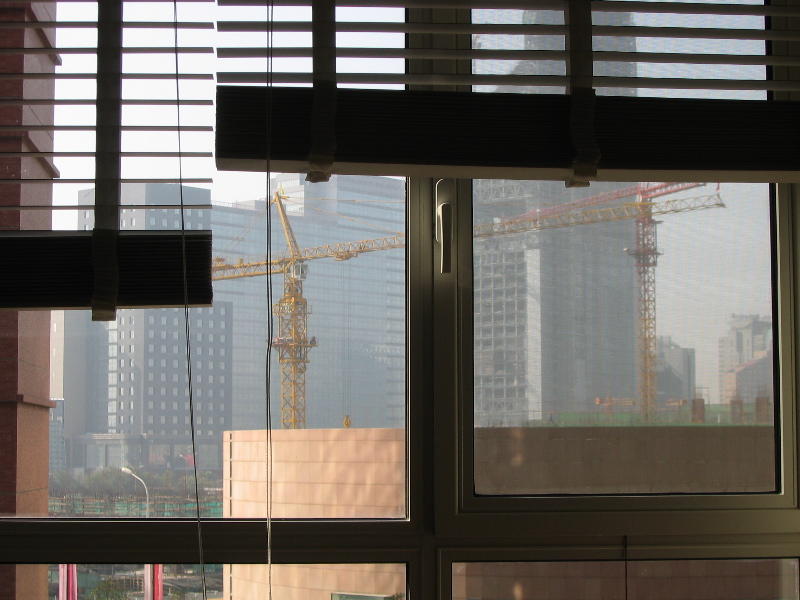
It’s 10 am in the morning and I’m listening to KQED (the San Francisco public TV/radio station) streaming online and doing my part-time job. Directly ahead outside the window of my study, two construction cranes are waltzing away on the site where two business towers will stand one day. Behind them is the soaring Beijing TV Tower in construction, its empty metal frames glistening in the morning sunlight.

NPR is doing a show on obesity and dieting. First they interview the director of Supersize Me. The director summarize his 1.5 hr documentary in 30 seconds – he ate three meals a day at McDonald’s for 30 days; he supersized everytime he was asked; he gained weight and suffered headaches, trouble with breathing, high cholesterol, and many other health problems. “McDonald has the responsibility to inform its customers of the danger of its food”, he exclaims.

Next the program talks to an obese woman who, inspired by Supersize Me, did a similar documentary by eating three meals a day at McD, but lost 10 or 20 pounds in the end. Unlike the Supersize Me director who didn’t exercise, this women worked out.

Neither is your average McD customer. But hey, if it’s any more scientific, it wouldn’t be art.

The program then moves on to an expert of something, who lambastes the diet industry for conspiring in fanning the hysteria on weight loss. He claims that there is no clear-cut scientific evidence supporting the position that obesity by itself causes health problems. Getting on and off dieting does more damage, he says.

Lastly a female writer comes on. She’s fat, she struggled with dieting all her life, now she’s resigned to be fat and be proud of and positive about it. She hates her friends and relatives who constantly pester her with suggestions of the latest fad diet.

Nobody talks about public health, statistics, or any sort of data. It’s very personal, subjective and, to many, engaging.

Right by my laptop on the desk sits the latest Time Out Beijing magazine. It opens to the article I was reading on the modern architecture Beijing is ferociously building. A Western architect laments that Beijing is in danger of becoming, like New York, an ultra-modern wasteland of architectural mediocrity.

Outside of my windows, the cranes continue their languid dance in their conspiracy to transform Beijing into this mediocrity (Come to think of it, New York is really not that bad, is it?). The radio show is now interviewing an American sumo wrestler who’s huge in size.

I have a sudden attack of where-am-I-now confusion, which I guess is common to bourgeoisie intellectuals with no much time on their hands. On the other end of the Internet (does the Internet have ends?) is America, a future that Beijing is sprinting towards. It’s a future in which Beijingers will have more modern buildings, eat more McD hamburgers, become more obese, and have talk shows discussing the personal opinions on dieting.

Based on the number of fat businessmen and government bureaucrats roaming the streets everyday, it seems we are already half way there.

Tuesday, October 18, 2005

Blame it on Maria Callas


I got up in the morning with a cold. After finishing breakfast, I sat down in front of my computer with my coffee to start my daily routine – an hour’s part-time work for Google to make my meal money, then writing, and stressing over not being able to write.

I listened to Maria Callas and surfed the web a little. There’s news that the famous writer Ba Jin had just passed away. I read a long speech given by him to some Japanese friends about his life. (for the full text in Chinese, click this)

Ba Jin is also from Chengdu, my hometown. Growing up he was considered a hero, a good son who brought honor to all Sichuanese. The irony is that in his work he lashed hard at the repressive society in Sichuan. Here’s what he said about his growing up experience:

“I grew up in a big landlord family, and spent my childhood between 20 or 30 so-called ‘upper-class’ people and 20 or 30 so-called ‘lower-classed’ people. In the wealthy environment I was in touch with the tragic lives of the servants and sedan carriers. Under the pressure of the hypocritical and selfish elders, I heard the moaning of youth.

I felt that there’s something wrong with our society. But I wasn’t sure what the cause was, or how to fix it. I regarded my big family as an autocratic kingdom. I sat in the prison of old social mores, watching many dear to me struggling, suffering, without youth, without happiness, and eventually succumbing to a painful death. They were killed by the feudal ethics, traditional ideas and the capriciousness of a few individuals. I left my family as if running away from an intimidating shadow.

When I was 23, I ran form Shanghai to a completely strange Paris, looking for a way to save the people, save the society, and save myself. To say that I wanted to save the people and the society, that was exaggerating. But to save myself, that was completely true…”

Ba Jin’s oldest brother, the proto-type for the protagonist of his most famous work, Family, committed the day before the book came out. Ba Jin had dedicated the book to him.

Reading his speech was a wild emotional ride for me. It reminded me of my teenage years shaking in tears while reading Family late at night. It painted a heart-rending picture of the absurdity of the Cultural Revolution in which he yielded to the communist control of his creative freedom. Most of all, I was surprised at the honest passion in this speech, given when he was probably in his 70s. Nothing short of a pure soul could voice yearnings so candid after the many tribulations in his life.

He was nominated once for the Nobel Prize in Literature. But Chinese did not see one of their sons winning the prize until Gao Xinjian, residing in Paris and contemplating the dislocated existence of modern society, wrote a book that befittingly explored humanity in a fashion appreciated by the Western critics and the Nobel committee.

I’d heard people dismissing Gao Xinjian, comparing him to other famous Chinese writers like Ba Jin. It is indeed a pity that readers outside of China are not more knowledgeable about Ba Jin’s work. But I don’t think it would have mattered to him a bit. Here’s a paragraph of what Ba Jin said about his work:

“My life is full of conflicts, so is my work. The conflicts between love and hate, thoughts and behavior, reason and emotion, ideals and reality… All of these weave into a net which covers my entire life, my entire work. Every piece of my work is the vocalization of my pursuit of light… When I wrote I never worried over creative method or expression tactics, etc. I spent all my time thinking and thinking about only one thing – how to make people’s lives better, how to be a better person, how to help my readers, and how to contribute to the society?”

Ba Jin remained to his last days a passionate son who suffered and wailed with China, with a humble yet persistent voice that reminded others of hope.

For a moment, Ba Jin’s words on his own life shook me as much as his book Family did to the teenage me.

Blame it on Maria Callas.

Here’s my little tribute to you, Mr. Ba Jin.